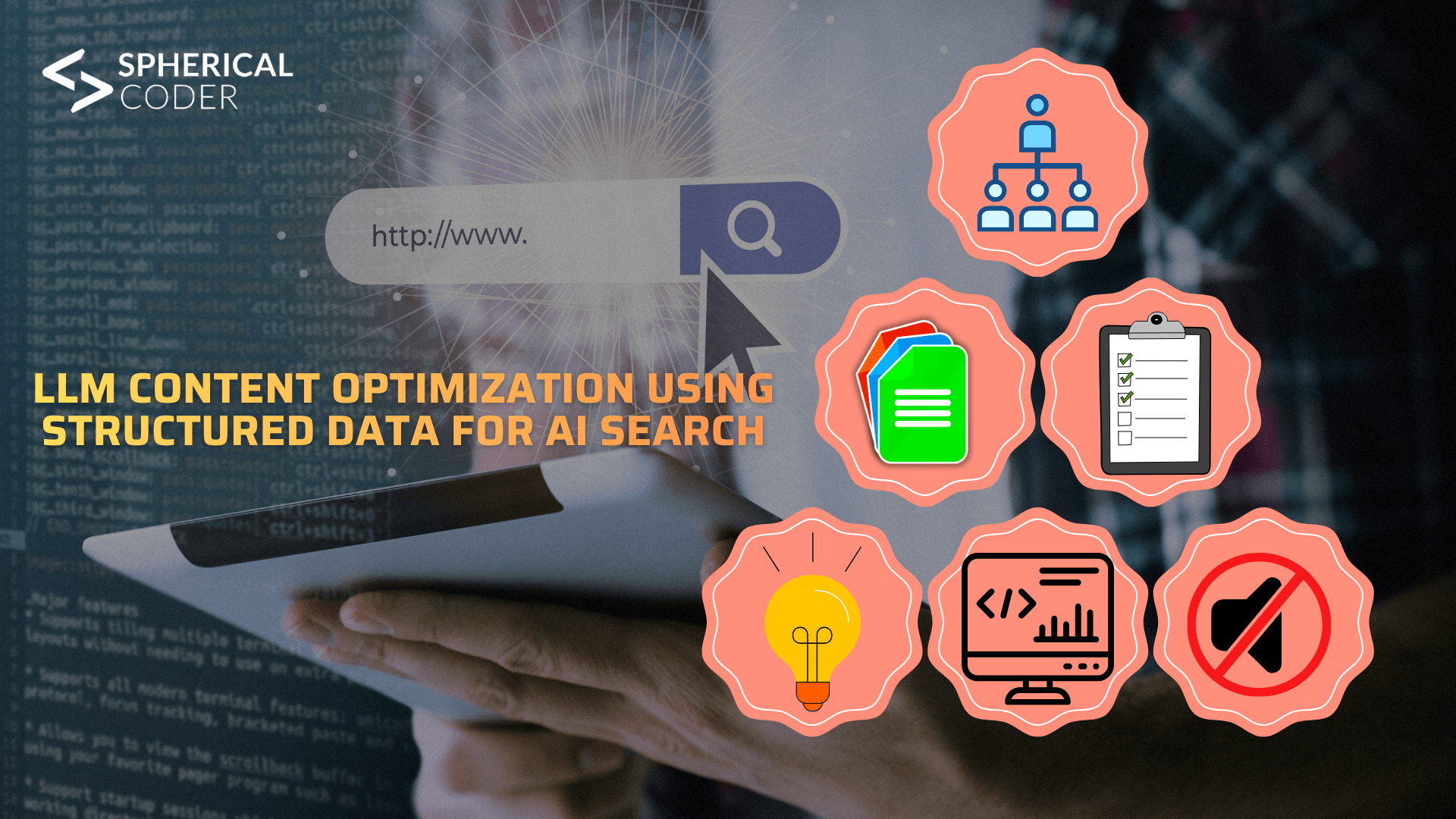
LLM Content Optimization Using Structured Data for AI Search
Structured data helps AI and search engines accurately interpret content, improving visibility, relevance, and AI-driven search performance.
LLM Content Optimization Using Structured Data for AI Search
Structured data or schema is the layer that can help translate your content into signals that machines can better interpret. Structuring content isn’t the same as structured data.
Use clarity, formatting, and hierarchy for improving your visibility in AI results.
Some research suggests that structured data may not play a role in direct AI overview visibility. Even so, Google advises using structured data to ensure content performs well in Google’s AI experiences, and so it’s one of those practices that require experimentation.
Google says: “Structured data is useful for sharing information about your content in a machine-readable way that our systems consider and makes pages eligible for certain search features and rich results.”
Many in the industry are already implementing or planning to implement schema/structured data as part of their GEO strategies.
The SEOFOMO State of AI Search Optimization Survey, 2025 Edition, shows that structured data/schema was most frequently mentioned as a way to optimize for AI search.
Structured Data Improves the accuracy of LLM Responses
Schema Markup serves as a direct pipeline for feeding LLMs with precise information, eliminating guesswork in content interpretation. When AI systems encounter structured data, they receive explicit context about entities, relationships, and factual details rather than inferring meaning from unstructured text alone.
AI-powered search engines leverage Schema Markup to deliver more targeted responses to user queries. The structured format enables LLMs to accurately match user intent with specific data points, thereby reducing the likelihood of generating irrelevant or tangential answers. These accuracy improvements become particularly evident when users search for specific facts, dates, or numerical data.
How LLMs Actually Interpret Web Content
LLMs interpret content differently, unlike traditional search engine crawlers that heavily rely on markup, metadata, and link structures.
They interpret patterns, structure, and context. Content structure matters; clear headings, lists, FAQs, and schema make your content easier for AI to parse and cite.
LLMs don’t “read” a page as humans do. They process it as tokens, small chunks of text, and rely on patterns and relationships to understand meaning. Instead of focusing on keywords alone, they look at the overall flow, context, and structure of the content.
When asked a question, the model retrieves the most relevant segments, identifies the clearest passages, and uses them to generate a response. This is why structured, scannable content is far more likely to be surfaced in AI-generated answers than long, unbroken blocks of text.
Key Signals LLMs Use To Interpret Content include - 1. Heading hierarchy & order, 2. Context & relationships, 3. Entities over keywords, 4. Formatting cues (lists, tables, FAQs), 5. Focused paragraphs, 6. Semantic & redundancy cues, and 7. Supportive signals.
Structure Matters in AI Search
When responding to queries, LLMs construct answers by stitching together relevant segments rather than giving full pages. Clean structure ensures your content is selectable for citation or summarization, even if the rest of the page isn’t used.
In short: to get surfaced in AI-powered answers, your content must be structured, clear, and scannable, not buried under poor formatting.
What gets understood most reliably? Content that is:
- Segmented logically, so each part expresses one idea.
- Consistent in tone and terminology.
- Presented in a format that lends itself to quick parsing (think FAQs, how-to steps, definition-style intros).
- Written with clarity, not cleverness.
LLMs Looking For When Parsing Content
- Clear headings and subheadings
- Short, focused paragraphs
- Structured formats
- Defined topic scope at the top
- Semantic cues in the body
How to Structure Content for AI search
For increasing your odds of being cited, summarized, or quoted by AI-driven search engines, think less on writer and focus on an information architect and structure content accordingly as per AI search. This means that presenting ideas in a format makes it easy to extract, interpret, and reassemble.
Core Techniques for Structuring AI-Friendly Content
- Use a logical heading hierarchy
- Keep paragraphs short and self-contained
- Use lists, tables, and predictable formats
- Frontload key insights
- Use semantic cues
- Avoid noise
How Schema Still Supports AI Understanding
Google recently confirmed at Search Central Live in Madrid that its LLM (Gemini), powering AI Overviews, is leveraging structured data for understanding content more effectively. In fact, at the event, John Mueller recommend to use structured data.
If your content isn’t already structured and understandable, schema can help fill the gaps. It’s a crutch, not a cure. Schema is a helpful boost, but not a substitute, for structure and clarity.
The content that is well-organised, well-written, and easily parsed shows up in citations and summaries in AI-driven search environments without any structured data.
Schema markup matters:
- Because AI systems like Google AI overviews, ChatGPT, and Perplexity, and other heavily rely on structured data for understanding, summarizing, and citing content accurately
- It gives search engines clearer signals about what content is
- It increases the chances of content being cited in AI-generated answers across search, chat, and voice surfaces
Schema makes your content easier for machines to interpret. It is a helpful boost.
Prioritize clear structure and communication first, and then use markup to reinforce, not rescue your content.
Conclusion
LLM optimization doesn’t mean chasing tools or hacks. It means doubling down on what good communication has always required: clarity, coherence, and structure.
You would need to structure content for AI search just as carefully as you structure it for human readers.
Best performing content in AI, which means:
- Anticipating how content would be interpreted, not just indexed
- Giving AI the framework for extracting ideas
- Structuring pages for comprehension, not compliance
- Anticipating and using language your audience uses, as LLMs respond literally to prompts and retrieval depending on those exact terms being present.