
Google Reveals the Signals Behind Canonical URL Selection
Canonicalization in technical SEO is complex. Google uses nearly 40 signals—not just canonical tags—to select the preferred URL in search results.
Google Reveals the Signals Behind Canonical URL Selection
In technical SEO, canonicalization is one of the most misinterpreted concepts. Google has to determine which version of a URL should show up in search results when they include identical or strikingly similar information. Google recently said that in order to select the preferred canonical URL, its system uses dozens of signals, totaling about 40. This realization clarifies the true complexity of the process and explains why merely adding a canonical tag does not always ensure the desired result.
Why Canonicalization Matters
Websites frequently have duplicate URLs. URL parameters, tracking tags, HTTP vs. HTTPS versions, www vs. non-www variations, pagination, and even small structural variations can all be used to create them. Duplicate material can mislead search engines, split backlinks, and weaken ranking signals if it is not managed correctly. Google wants to create a single primary version of a page that incorporates signals like authority, relevancy, and links. The canonical URL is the version that was chosen.
It’s Not Just One Signal
Many site owners assume that adding a rel= “canonical” tag solves everything. While the canonical tag is a strong hint, Google considers it just one signal among many. Canonical selection is based on a mix of technological, structural, and quality-related factors, according to explanations and documentation supplied via Google Search resources. Together, these signals identify the URL that most accurately captures the information.
Key Signals That Influence Canonical Selection
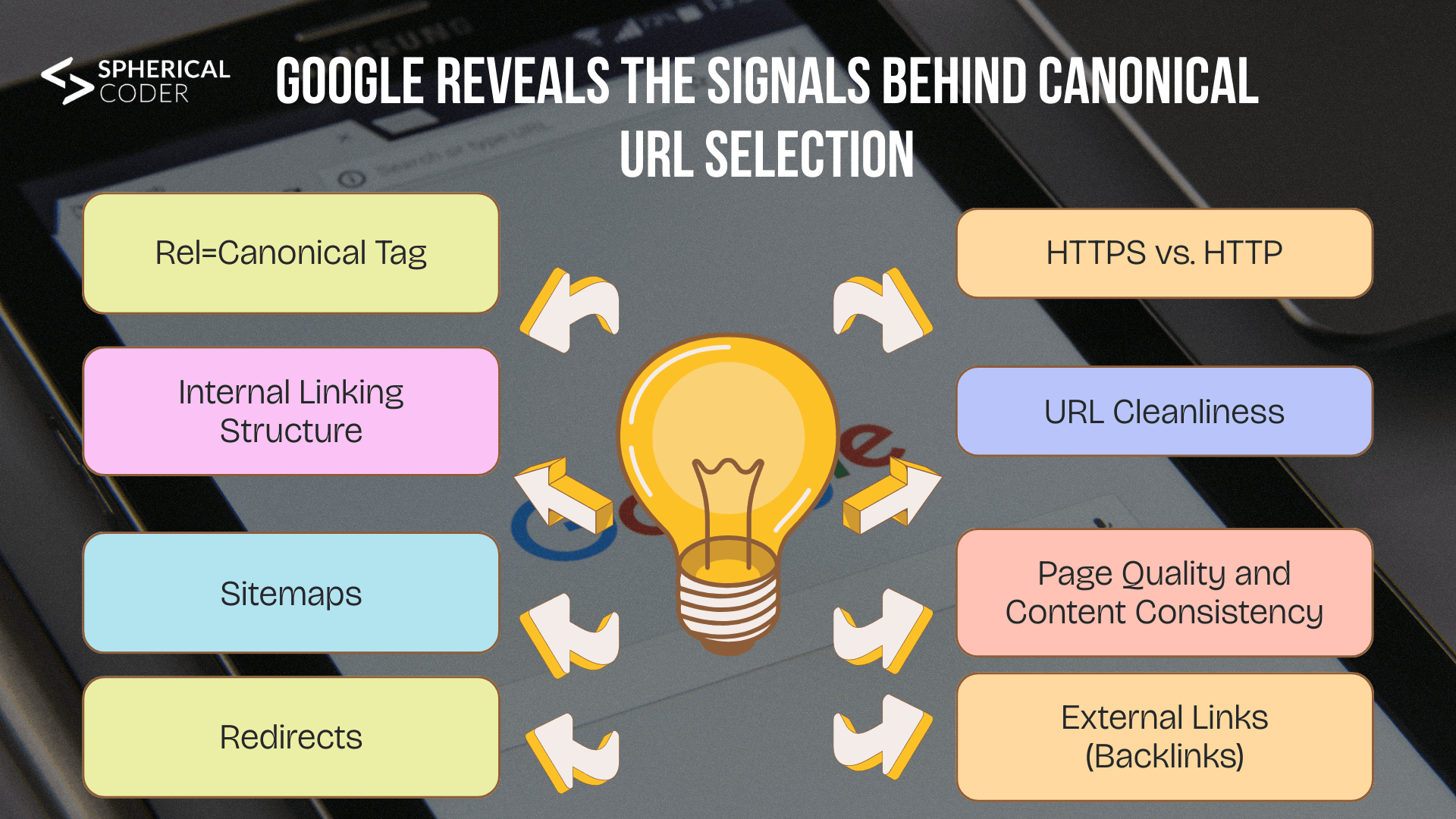
Although Google does not publicly list all 40 signals in detail, several known factors play a significant role:
1.Rel=Canonical Tag
The preferred version is indicated directly by the site owner. It's frequently respected when done right and repeatedly.
2.Internal Linking Structure
Google is more likely to consider one version of a URL as canonical if your website often refers to it inside.
3.Sitemaps
Preferred candidates are URLs that are part of XML sitemaps. Canonical signals are reinforced when consistent URLs are sent.
4.Redirects
Redirects (301) that are permanent strongly indicate consolidation. The destination is usually selected as canonical when one URL reroutes to another.
5.HTTPS vs. HTTP
When both are available and provide the same material, secure versions (HTTPS) are typically favored.
6.URL Cleanliness
Shorter, parameter-free URLs are often favored over long dynamic URLs with tracking parameters.
7.Page Quality and Content Consistency
Consistency of Content and Page Quality.
8.External Links (Backlinks)
A certain version of a URL may be chosen as canonical if the majority of backlinks point to it because it conveys greater authority signals.
Why Google Might Ignore Your Canonical Tag
Even when a canonical tag is implemented, Google may choose a different URL if:
- The canonical target returns an error
- There are conflicting canonical signals
- Internal links contradict the canonical tag
- The canonical page is noindexed
- The content differs significantly
Google's algorithms assess the signals' general consistency. In the event that your technological configuration gives conflicting signals, the algorithm selects the version it considers to be the most trustworthy.
Best Practices for Strong Canonical Signals
To improve canonical accuracy:
- Use consistent internal linking
- Implement self-referencing canonical tags
- Avoid unnecessary URL parameters
- Redirect outdated or duplicate pages
- Ensure canonical URLs return 200 status codes
- Keep sitemaps updated and aligned with canonical URLs
The Bigger Picture
Canonicalization is more complex than a toggle. Numerous signals are analyzed simultaneously by sophisticated algorithms that make a weighted decision. Knowing this enables SEO specialists to concentrate more on structural clarity and less on fast solutions. Canonical decisions still depend on signal consolidation rather than a single direction as search systems develop. The conclusion is obvious: maintaining consistency in the technological and content architecture of your website is crucial