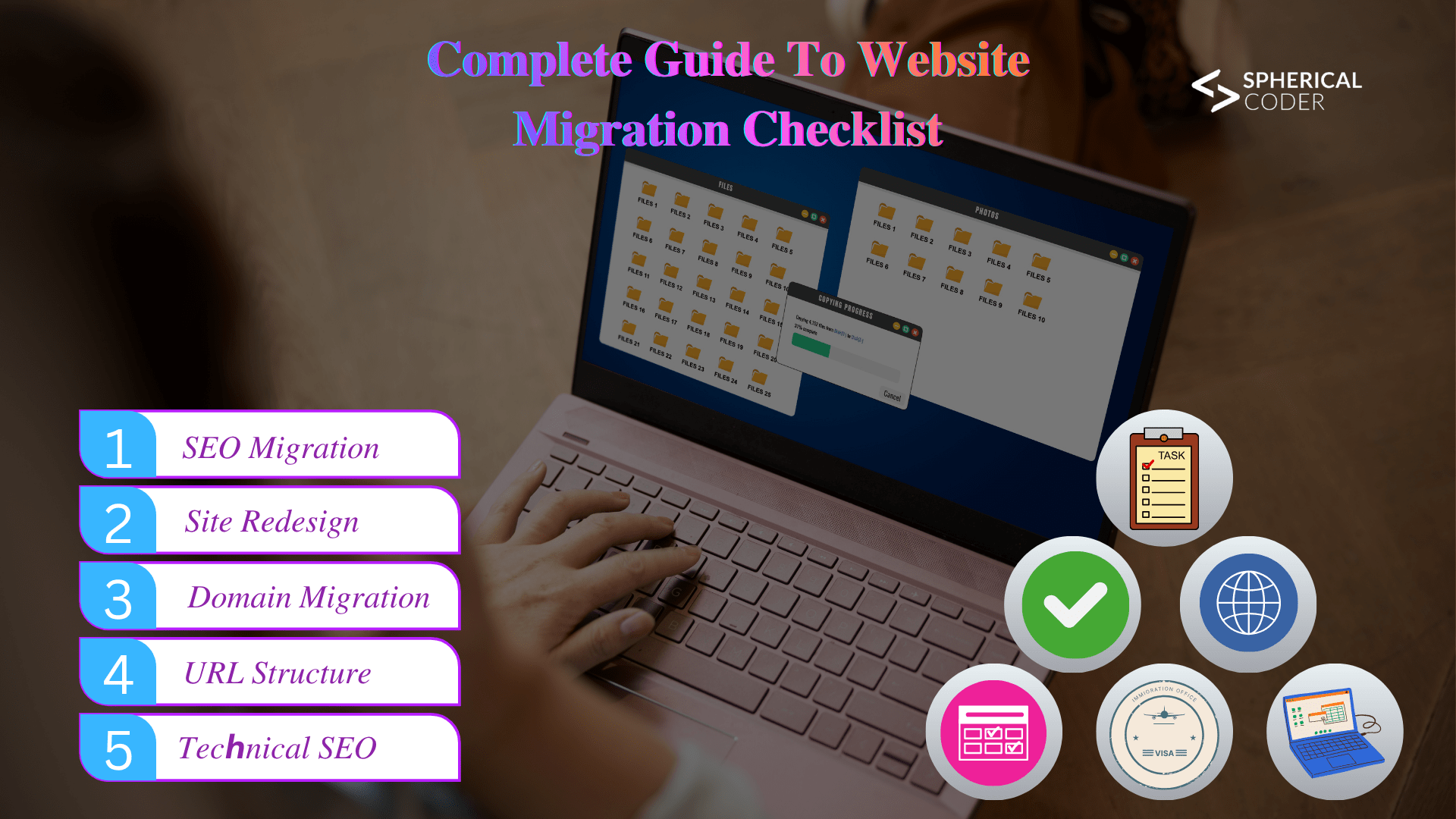
Complete Guide To Website Migration Checklist
Website migration involves major changes to a site’s structure, technology, or hosting to enhance security, improve user experience, and boost SEO performance.
Complete Guide To Website Migration Checklist
There are several reasons behind migrating a website, and that might be to enhance website security through another hosting provider, updating brand image, or improving user experience.
Website migration is the process of making major changes to a website’s technology, structure, design, or location. Usually, to improve the site’s user experience and SEO performance.
Common reasons for website migration include:
- Moving to a new framework or website platform for improving your site’s performance, security, or functionality.
- Changing your website architecture to a more organized website structure for improving user experience and your SEO results.
- Moving from HTTP to HTTPS aids in securing your site by encrypting visitors’ information, and is highly recommended by Google.
- Moving to a new server, to a new host, could speed up your site overall, especially when it is growing. While a fast site is good for visitors and search engines.
- Changing your domain name as a part of a rebrand, you will want to move old content over to the new website.
Following the migration process enables updating your site without compromising SEO rankings, traffic, and revenue. However, the strategy may prevent data loss, performance dips, and downtime while moving the site to a new domain, hosting platform, or CMS.
16-step checklist of the website migration process
- 1 : Planning
- Define project scope
- Set migration team and responsibilities
- Manage cross department and stakeholder expectations
- Define your timelines and launch data
- 2 : Pre-migration
- Run a detailed risk assessment
- Define performance benchmarks and set up tracking
- Ensure Dev and SEO are aligned on performance
- Document everything
- Set up a testing environment
- Conduct a content inventory
- Create a redirect map
- Run pre-launch checks
- 3 : Launch
- Launch and promote your new site
- 4 : Post-Migration
- Optimize your website performance
- Update technical documentation
- Implement basic maintenance practices
Before you start to begin development,
Firstly, take inventory of all webpages. Your migration is set to fail if you don’t have a well-defined goal and scope.
Then, set up a project management framework to keep tabs on tasks belonging to them.
Identify stakeholder expectations in the migration process. This often includes designers, IT staff, quality assurance testers, content managers, product designers, and marketers, alongside SEO and dev teams. It involves scheduling a meeting to explain the needs and aims, providing an excellent opportunity for gathering feedback on their specific needs.
Extending the planning stage to the pre-migrating stage, you set the foundation for a smooth transition and minimizing during or post-migration.
In the Pre-migration stage,
Audit webpages and then rank the risks by their impact on business using a simple low-medium-high scale, followed by tackling the most critical.
Creating an effective mitigation plan for minimizing severity of risks, involves some techniques:
- Backup of all content, meta-data, and configurations before migration
- Using a risk assessment matrix for measuring the risks involved in the website migration process and its impact on your business goals
- Use a staging environment for testing changes before it goes live
- Implement 301 redirects for all the changed URLs
Detailed picture of your site’s existing performance enables comparison with the new site.
It’s a good idea to back up the existing site in case you need to restore it during the migration process. Pull the benchmark data for:
- Core web vitals
- Server response time
- Database performance metrics
- Usability testing
- Overall website performance
Further, double-check that you’re tracking all your target keywords in your rank-tracking tool.
Technical overhaul, including a CMS change, server migration, or redesign, let your developers know the SEO performance metrics are important. This helps minimize migration’s impact on SEO performance.
Documenting all your active server settings and configurations, which includes the details about the DNS settings, CDN configurations, and hosting environment. Its several benefits are
- Ensuring a new server environment mirrors the old one and reducing risks of inconsistencies
- Problems arising post-migration, detailed server documentation, which makes it easier for relevant teams to find, diagnose, and resolve
Tools for documentation include configuration management tools such as Ansible, Puppet, or Terraform that are popular for documenting server configurations, while Git, a version control tool used for tracking changes made and collaborating effectively during the migration.
Developing your site in a closed testing environment on a separate server to verify the proper functioning of the new site before launching. This is a staging website, where you can try out all functionalities without disrupting operations on the live website. It also enables identifying and fixing any potential issues or conflicts before the migration process.
Now, conduct a content inventory, which involves building a complete overview of your existing content and pages. It lets you identify if anything goes missing during the migration.
This is helping you to benchmark your performance before and after the migration process.
Next is creating a redirect map, which involves the use of your URL list for determining the pages to move to the new site, which ones you can merge, and which ones to drop.
Use redirecting links to connect your old content to the new one. So that when users try to access the content on your old page, they’re automatically redirected to the latest version of it.
After completing the redirect map, share the list of new URLs for updating their campaign links once the new site launches. This is called a chain redirect, and it confuses search engine bots when they try to crawl and index the page.
Ensure your redirects are one-to-one and are ideally not going through redirect chains.
Run pre-launch checks, before launching your new site, in which you will need to run various checks in your testing environment for ensuring new site functions as expected.
Confirm that the following elements are meeting the required standards while working with the SEO team:
- Test redirects
- XML sitemap
- Robots.txt File
- URL structure
- Canonical URLs
- Structured data
- Status codes
- Internal linking
- Title tags, header tags, and meta descriptions
Proceed to Launch website :
Launch and promote the new site by lifting any user and search engine restrictions that were set up during the development phase.
Remove all limitations that were placed. This includes robots.txt disallows, no index tags, and password protection.
Also, make sure your DNS records point to the right servers after migration.
This is a good idea for planning PPC campaigns to coincide with the site launch. Not only will this spread the word about your new site, but it can also help make up for the short-term organic traffic dips you experienced during the migration process.
Lastly, recheck all the changes to ensure everything is working as intended.
Sometimes, the migration may not go as planned, and this is where you decide to tweak your edits or roll back to the previous website.
Monitor the new website to verify whether everything is working as it should, and critical aspects like your new robot.text file, XML sitemap, redirects, usability, and analytics. Also, check for your website performance comparing with your old site. For optimizing website:
- Use website caching to store content/data for faster user access
- Use a CDN to reduce latency and improve content delivery time
Now, it's time to revise technical documents in order to ensure that they are accurate and up-to-date. The documentation guides the migration process and mitigates the risks like supplicate/lost content, missing/broken links, etc.
Set preventive maintenance practices to keep your website functioning properly after the backup. This helps you catch and resolve potential issues.
Google Search Console, Screaming Frog, Ahrefs, and Semrush are some of third party SEO tools used as monitoring systems for tracking performance metrics and detecting anomalies affecting web performance.