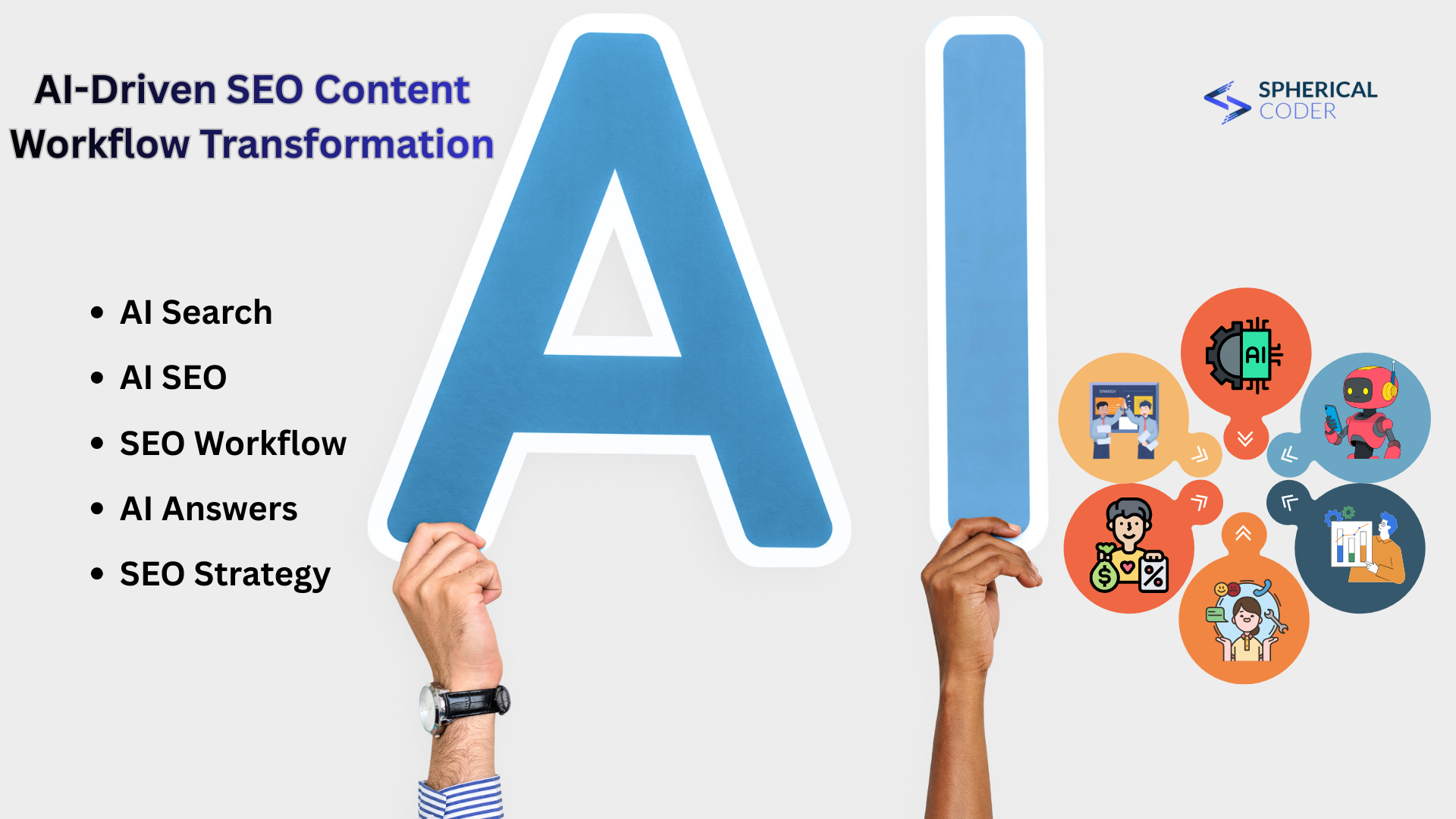
From Organic Search to AI Answers: How to Redesign SEO Content Workflows.
AI-powered search is transforming SERPs as users shift to faster, smarter answer engines for online visibility.
From Organic Search to AI Answers: How to Redesign SEO Content Workflows
End of Organic Search
As per a recent survey, 83% consumers believe that AI-powered search tools are more efficient than traditional search engines.
Simple searches are long gone, and a profound transformation is continuing to sweep the search engine results pages (SERPs). AI-powered answer engines, from ChatGPT to Perplexity to Google’s AI Overviews, are rewriting the rules of online visibility.
AI systems are returning to immediate results instead of returning traditional blue links or images.
For market leaders, the question is no longer “How do we rank number one?” but rather “How do we become the top answer?”
The shift has eliminated the distance between the search and the solution. No longer do customers need to click through to find the information they are seeking.
What Generative Engines Changes and Why “Traditional SEO” Won’t Recover
Generative search engines give a quick, synthesized answer instead of presenting a list of websites to click through to learn more. The source of the answer is cited, enabling users to click to learn more if they so choose to. These citations are the new “rankings” and most likely to be clicked on.
As per the research, 60% consumers click through at least sometimes after seeing an AI-generated overview in Google Search. While a separate study found that 91% of frequent AI users turn to popular large language models (LLMs) like ChatGPT for their searching needs.
Furthermore, keyword optimization is holding importance in content marketing, and generative engines are favouring expertise, brand authority, and structured data. For CMOs, the old metrics no longer necessarily equate to success, while visibility and impressions are no longer tied to website traffic, and success is now contingent upon citations, mentions, and verifiable authority signals.
In this new search era, improving visibility can be measured in three diverse ways:
- Appearing in results or answers.
- Being seen as a thought leader in your space by being cited or trusted as a credible source.
- Driving influence, affinity, or conversions from your digital presence.
The CMO’s New Dilemma: AI as Both Channel and Competitor
With over half of consumers (56%) trusting the use of GenAI as an education resource, generative engines are now mediators between your brand and your customers. Influencing purchases or swaying customers towards your competition depends on the content earning hard-earned trust.
If a customer asks, “What’s the best CRM for enterprise brands?” and an AI engine suggests HubSpot’s content over your brand, the damage isn’t just a lost click but a missed opportunity to garner interest and trust with that motivated searcher.
The GenAI model didn’t see your content as relevant or reliable enough to deliver in its answer.
As GenAI are trained on content already existing, which means competitors’ content, user reviews, forum discussions, and your own material, AI is considered both a discovery channel and a competitor for audience attention. CMOs recognizing this duality aid in investing in structuring, amplifying, and revamping content workflows to match gen AI’s expectations.
It is ultimately shaping the content in a meaningful way to ensure those algorithms trust and view your content as the single source of truth.
Redesigning SEO Content Workflows for the Generative Era
- From keyword targeting to knowledge modelling
Generative models go beyond understanding just keywords, as they also understand entities and relationships. Showing up in coveted AI answers and being in top choice, reflecting content structured and interconnected knowledge.
- From content volume to verifiable authority
There is no such case as ‘more content, the better’ with SEO today, as AI systems prefer content that is well-sourced, attributable, and authoritative.
Creating an AI-readiness checklist for their content marketing team ensures that every piece of content is optimized for generative engines. Every article should include author credentials (job title, advanced degrees, and certifications), clear citations (where the statistics or research came from), and verifiable claims.
- From static publishing to dynamic feedback
Generative engines are evolving similarly to traditional search.
Successful SEO teams are adopting an agile publishing cycle to continuously stay on top of what is working best.
SEO teams are actively and consistently testing which questions their audience asks in GenAI, tracking whether their content appears in those answers, and refreshing content based on what’s being cited, summarized, or ignored.
Several tools are emerging to help you track your brand’s presence across, ChatGPT, Perplexity, AI Overviews, and more, including SE Ranking, Peec AI, Profound, and Conductor.
How to Measure SEO Success in an Answer-Driven World
Measuring SEO success across generative engines looks different from how we used to measure traditional SEO.
For CMOs, understanding how to measure marketing’s impact is important for demonstrating the value your team delivers to the organization’s mission.
Progressive CMOs are redefining SEO success:
- AI Citations
- Answer Visibility Share
- Zero-Click Exposure
- Answer Referral Traffic
- Semantic Coverage
These metrics are moving SEO reporting from vanity numbers to visibility intelligence and are a more accurate representation of brand authority in the machine age.
Final Thoughts
Future Proof SEO for Generative Search
Generative search is as volatile as traditional search, but volatility is fertile ground for innovation. CMOs should continue to treat SEO as an experimental function, a sandbox for continuously testing new ways to be discovered and trusted. SEO continues to remain a function that isn’t a set it and forget it, but one that must change with time and testing.
“Organic Search” would become something broader to encompass the fast-growing ecosystem of machine-mediated discovery. The brands that succeed won’t just optimize for keywords. They’ll build long-lasting trust.
The Next Evolution of Search
AI isn’t eliminating SEO but rather redefining what it means today.
In the age of AI answers, your brand doesn’t need to just be searchable; it needs to be knowable.