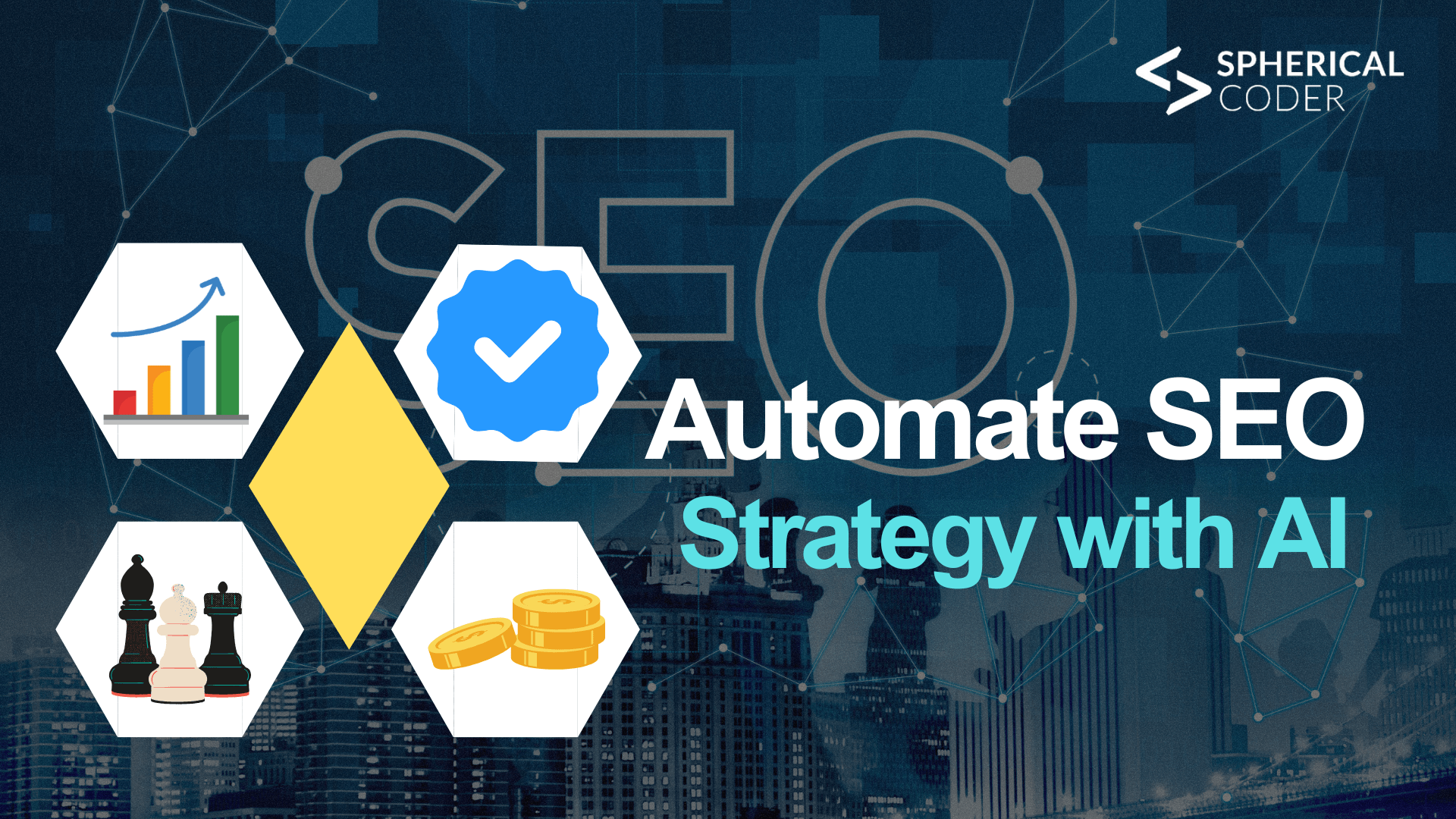
Automate SEO Strategy with AI
Generative AI uses deep learning to create original content from user prompts quickly and intelligently.
Automate SEO Strategy with AI
The rise of generative AI tools is capable of producing written content.
Generative AI, sometimes called genAI, is an artificial intelligence (AI) that can create original content like text, images, video, audio or software code in response to a user’s prompt or request.
It relies on sophisticated machine learning models called deep learning models algorithms simulating the learning and decision-making processes of the human brain. The models work by identifying and encoding the patterns and relationships in a huge amount of data, and then using that information to understand users’ natural language requests or questions and respond with relevant new content.
Impact of Generative AI on SEO Strategies
According to our survey, most (81.5%) SEO professionals report that generative AI has already had some effect on their SEO strategy.
It was reported that executives are most concerned about how generative AI will impact their SEO tactics; 37% of them anticipate a significant influence.
On the other hand, business owners/operators (24%) and freelancers (23.5%) are more certain that generative AI won’t force them to alter their SEO strategy significantly.
SEO automation with AI
Brands are using AI-powered tools for automating keyword research, content creation, on-page optimization, and technical audits.
The shifting from SEO to Generative Engine Optimization (GEO) or Answer Engine Optimization (AEO)-digital strategies designed for AI-first search.
Instead of spending hours on keyword research, content optimization, or technical audits, AI tools can handle these repetitive steps, freeing up time to focus on strategy and creativity.
At its core, automation of routine SEO tasks, including keyword clustering, rank tracking, backlink analysis, internal linking, and on-page audits, can be done automatically.
AI-powered intelligence: Beyond automation, AI tools analyze large data sets, predict search intent, and even generate content optimized for both humans and search engines.
Some of the Top AI SEO Automation Tools include -
- Keyword research and clustering
- Semrush Keyword Magic Tool with AI Assist
- Ahrefs with AI-Powered Keyword Insights
- Vendasta AI-Powered Local SEO
- Content Creation and Optimization
- Jasper AI
- Vendasta AI Content Creator
- Surfer SEO
- Clearscope
- On-Page SEO Enhancements
- MarketMuse
- Frase.io
- Yoast SEO Premium with AI Integration
- Technical SEO Audits
- Screaming Frog SEO Spider with AI Enhancements
- DeepCrawl (Lumar)
- Sitebulb
- Link Building and Backlink Analysis
- Pitchbox
- BuzzStream with AI Prospecting
- Link Whisper
- Performance Tracking and Reporting
- Google Analytics 4 with AI Insights
- SE Ranking with AI Forecasting
- Moz Pro with AI-Powered Rank Tracking
- Vendasta SEO Reporting & Citation Builder
Why Technical SEO Needs Automation
The pressure to maintain optimized sites at scale increases with the sophistication of search engines. There are three main reasons why automation is needed:
- Increasing search complexity: Google’s algorithms, like BERT and MUM, emphasize context and user intent, necessitating more intricate technological accuracy.
- Real-time performance optimization: Users demand immediate, pertinent results, which forces SEOs to make adjustments on the fly.
- Accuracy and speed: AI can handle massive datasets more quickly and precisely than humans, spotting trends that manual audits overlook.
AI is revolutionizing technical SEO, it includes -
- AI driven audits and diagnostics
- Structured data at scale with AI
- Dynamic optimization of site performance
- Entity based SEO: Future-proofing content strategy
- Personalization at scale
Benefits of AI-Powered technical SEO
- Efficiency and scalability
- Precision and accuracy
- Competitive advantage
- Cost-effectiveness
Concerns related to using AI in SEO
There is a growing concern about biased and inaccurate information in AI models, including ChatGPT. The model is trained on vast amounts of data, and if this data is biased or incorrect, the model will also be biased and unreliable. This can have serious implications, particularly in applications where decisions are made based on the model's output. Always cross-check information from the model with trustworthy sources to ensure accuracy.
With Bing’s AI Chatbot, the search engine is moving towards answering queries rather than presenting a list of resources that “could” answer the query.
While producing AI-generated content at scale may lead to immediate gains in traffic and visibility, it may not be sustainable in the long term. Large increases in organic traffic from mass-produced AI-generated content are likely attributed to the enormous coverage of frequently asked questions in a given industry.
To achieve long-term SEO success, it is crucial to produce high-quality content that adds value to users and stands out from the competition.
When evaluating the use of AI-generated content for SEO, it is important to consider whether the content aligns with the business goals of the website. Simply generating traffic and attracting visits is not enough if the content does not lead to conversions or meet the needs of the target audience.
Producing AI-generated content with careful consideration. Enterprise SEOs should not rush into producing AI-generated content without some careful consideration. And make sure that the content created by AI is of high quality, meeting the needs of users. If AI-generated content demonstrates E-E-A-T (expertise, experience, authoritativeness, and trustworthiness), then Google will not penalize it.
Duplicate content concerns with GenAI. As ChatGPT operates from a word-prediction probability algorithm, the technology doesn’t simply copy and paste identical content to each user who inputs a similar prompt.
It’s important to note that the uniqueness of AI-generated content may also depend on the input data and the parameters set for the AI model. Therefore, it's essential to continue monitoring and assessing the content to ensure that it doesn't result in any duplicate content issues.
Plagiarism concerns regarding GenAI. There is a concern regarding whether or not ChatGPT plagiarize content. When ChatGPT generate text, it is always “creating” rather than copying content exactly from other sources.
Minimizing the risk of plagiarism by-
1.Content fusion, facilitating AI-powered content creation, not allowing users to generate entire content pieces at once like other point solutions do.
2. Enabling the ability to create short paragraphs around specific contexts like headlines.
3.Content generated through Content Fusion should be used as a starting point. The brand knowledge, tone, creativity, and opinions of a human writer are true differentiating factors needed to be inserted into any generated content.
Security and privacy risks of using GenAI. It’s crucial to keep in mind that anything you enter into ChatGPT is saved and might be utilized for training and model improvement, among other things. Private information may be disclosed outside of the technology if this data is not handled appropriately. Additionally, as ChatGPT’s data is vulnerable to cyberattacks. Hackers may be able to access data contained in the system or use it to launch a more comprehensive attack if they can access it without authorization. Because of this, no sensitive data must be entered into the system.
While AI-generated content helps scale SEO efforts, it is important to be mindful of the risks and potential drawbacks associated with using the technology—particularly when it comes to content generation at scale.